Backup Power Solutions: Generators and Battery Systems for Home Resilience
Backup power solutions have evolved from luxury conveniences to essential home infrastructure as grid reliability concerns increase and extreme weather events become more frequent. In 2025, the average American home experiences 4-6 hours of power outages annually, with some regions facing significantly longer disruptions. For homeowners dependent on medical equipment, working from home, or simply unwilling to accept the inconvenience and costs of prolonged outages, reliable backup power is no longer optional.
According to Department of Energy data, power outages cost American businesses and homeowners over $150 billion annually in spoiled food, lost productivity, damaged equipment, and emergency accommodations. A single multi-day outage can result in thousands of dollars in losses for an individual household—far exceeding the cost of backup power systems that prevent these losses.
The concerns driving home backup power systems adoption extend beyond mere inconvenience:
Medical necessity: Homeowners dependent on oxygen concentrators, CPAP machines, refrigerated medications, or other medical equipment face genuine health risks during outages.
Work-from-home requirements: Remote workers cannot afford extended connectivity losses that jeopardize employment and income.
Food security: Refrigerators and freezers full of food represent $500-1,000 investments that spoil within hours during summer outages.
Climate control: Extreme heat or cold during outages poses health risks, particularly for vulnerable populations including young children, elderly individuals, and those with chronic health conditions.
Home security: Power outages disable security systems, smart locks, and surveillance cameras, leaving homes vulnerable.
At Energized Electric LLC, we help Portland-area homeowners evaluate backup power needs and install appropriate solutions—from portable generators to whole-home battery systems. This comprehensive guide compares available backup power technologies, helping you determine which solution best protects your family and property.
Understanding Different Types of Backup Power Systems
Selecting appropriate emergency power solutions requires understanding the capabilities, limitations, and costs of different backup power technologies.
Portable Generators: Entry-Level Backup Power
What they are: Portable generators are gasoline or propane-powered units that provide temporary power through extension cords or basic transfer switches. These units typically range from 3,000-10,000 watts capacity.
Advantages:
- Lower initial cost: Quality portable generators cost $500-2,000
- Flexibility: Can be moved to different locations or stored when not needed
- No installation required: Simply add fuel, start the unit, and connect devices via extension cords
- Multiple uses: Can power outdoor events, camping trips, or job sites in addition to emergency backup
Limitations:
- Manual operation: You must physically start the generator during outages
- Limited capacity: Most portable units cannot power whole homes, only essential devices
- Refueling requirements: Gasoline units typically run 8-12 hours per tank, requiring frequent refueling during extended outages
- Noise: Portable generators are loud (65-85 decibels), potentially disturbing neighbors
- Safety concerns: Risk of carbon monoxide poisoning if operated too close to homes or in enclosed spaces
- No automatic operation: Cannot provide seamless power during brief outages when you’re away from home
Best for: Homeowners seeking basic, occasional backup power for essential devices during short outages, or those with very limited budgets.
Standby Generators: Comprehensive Whole-Home Power
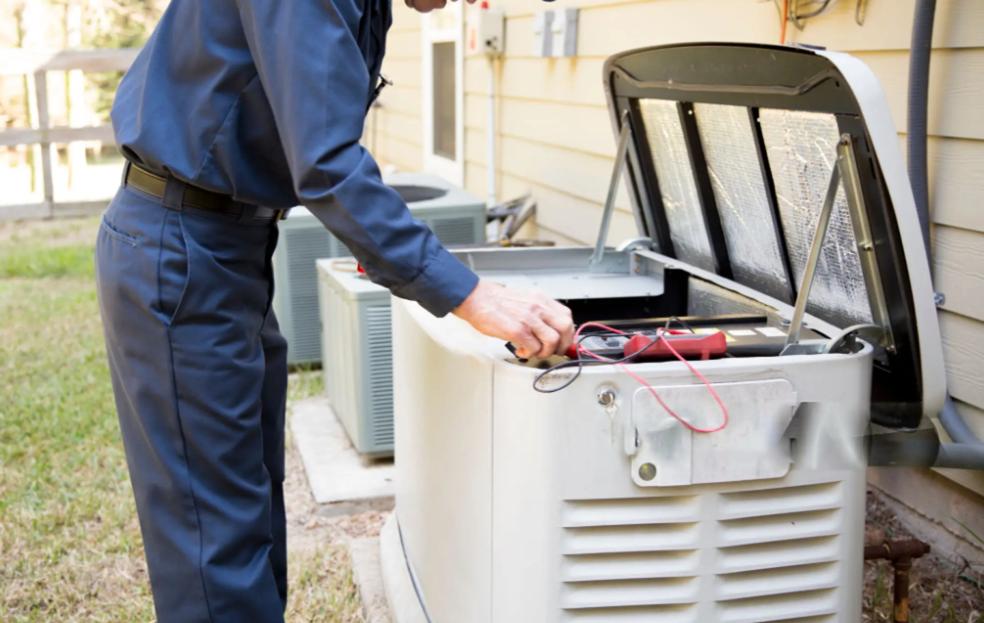
What they are: Permanently installed generators that automatically activate when utility power fails, providing seamless power to your entire home or selected circuits. These systems run on natural gas or propane and range from 7,000 to 50,000+ watts.
How they work: Standby generators continuously monitor utility power through automatic transfer switches. When outages occur, the generator starts automatically within 10-30 seconds and begins powering your home. When utility power returns, the system automatically switches back and shuts down the generator.
Advantages:
- Automatic operation: Provides protection even when you’re away from home
- Whole-home capacity: Properly sized systems power your entire house including HVAC, appliances, and electronics
- Continuous fuel supply: Natural gas systems never require refueling; propane tanks provide days or weeks of runtime
- Permanent installation: No setup or storage required—always ready when needed
- Quiet operation: Professionally installed units with enclosures operate at 60-70 decibels
- Home value increase: Installed standby generators add resale value to properties
Limitations:
- Higher initial cost: Installation costs range from $5,000-15,000 depending on capacity and complexity
- Professional installation required: Licensed electricians and gas fitters must handle installation
- Ongoing maintenance: Annual maintenance costs $200-400 to ensure reliable operation
- Fuel costs: Natural gas or propane consumed during outages
- Noise: While quieter than portable units, they still generate noticeable sound
Best for: Homeowners wanting comprehensive, automatic protection for the entire home, particularly those with medical equipment, home offices, or frequently absent from the property.
Home Battery Backup Systems: Silent, Clean Power
What they are: Large lithium-ion battery systems (similar to electric vehicle batteries) that store grid electricity and automatically provide power during outages. Popular systems include Tesla Powerwall, LG Chem RESU, and Enphase Ensemble.
How they work: Battery systems continuously charge from grid power (or solar panels if installed) and monitor utility supply. During outages, they seamlessly switch to battery power within milliseconds—so quickly that computers and sensitive electronics never lose power.
Advantages:
- Completely silent operation: Zero noise during charging or discharge
- Zero emissions: No exhaust, no fuel storage, no carbon monoxide risk
- Indoor installation: Can be installed in garages or basements without ventilation concerns
- Instantaneous switching: Power transitions are seamless—computers don’t reset, clocks don’t blink
- No maintenance: Batteries require no oil changes, filter replacements, or annual servicing
- Solar integration: Pairs perfectly with solar panels for true energy independence
- Grid services: Some utilities pay for access to your battery capacity during peak demand
- Clean, modern appearance: Sleek installations that don’t detract from property aesthetics
Limitations:
- Higher upfront cost: Systems typically cost $10,000-15,000 installed (before incentives)
- Limited runtime: Without solar panels, batteries provide 8-24 hours of power depending on capacity and usage
- Capacity constraints: Cannot power entire home simultaneously—must prioritize essential circuits
- Professional installation required: Complex electrical work requiring licensed electricians
- Solar benefits require panels: Maximum benefit requires pairing with solar panel systems
Best for: Homeowners prioritizing quiet, clean, maintenance-free operation, those with solar panels or planning to install them, and environmentally conscious individuals seeking sustainable backup solutions.
Hybrid Systems: Combining Technologies
Some homeowners install hybrid backup power systems combining different technologies:
Generator + Battery: Battery provides immediate seamless power for sensitive electronics while generator handles high-demand appliances and recharges batteries during extended outages.
Solar + Battery + Generator: Solar and batteries provide primary backup, with generator serving as final backup during prolonged cloudy periods with extended outages.
These hybrid approaches offer comprehensive protection but require significant investment and complex engineering.
Sizing Your Backup Power System
Properly sizing standby power systems ensures adequate capacity without overspending on unnecessary capability.
Calculating Power Requirements
Essential loads approach: Identify essential circuits you must power during outages:
- Refrigerator/freezer: 700-1,200 watts
- Furnace or heat pump: 1,500-5,000 watts (depending on size and type)
- Well pump (if applicable): 1,000-2,000 watts
- Lights (LED): 10-20 watts per fixture
- Internet modem/router: 50-100 watts
- TV and computer: 200-400 watts
- Microwave: 1,000-1,500 watts
- Coffee maker: 800-1,200 watts
Example essential load: 12,000 watts total requires a generator rated for at least 15,000 watts (accounting for starting surges and safety margin).
Whole-home approach: Calculate your home’s total electrical panel amperage and select generators sized accordingly:
- 100-amp panel: 20,000-24,000 watt generator
- 150-amp panel: 30,000-36,000 watt generator
- 200-amp panel: 38,000-48,000 watt generator
Professional load calculations: Experienced electricians perform detailed load calculations considering:
- Simultaneous demand factors (not all circuits operate at maximum simultaneously)
- Motor starting surge requirements
- Future capacity needs
- Budget constraints balanced against desired protection level
These calculations ensure optimal system sizing—adequate capacity without paying for unused capability.
Generator Sizing Considerations
Undersizing consequences: Generators too small for loads will:
- Overload and shut down automatically
- Fail to start high-demand appliances
- Provide unreliable power
- Experience premature wear and failure
Oversizing drawbacks: Excessively large generators:
- Cost more initially with no benefit
- Consume more fuel even under light loads
- May require larger fuel storage
- Can experience carbon buildup from constant light-load operation
Sweet spot sizing: Generators sized for 125-150% of calculated essential loads provide optimal balance of capacity, efficiency, and cost-effectiveness.
Battery System Sizing
Battery capacity vs. runtime: Battery size (measured in kilowatt-hours, kWh) determines runtime under load:
- 13.5 kWh battery with 3 kW load = 4.5 hours runtime
- 13.5 kWh battery with 1 kW load = 13.5 hours runtime
Typical battery system sizes:
- Single battery (10-13.5 kWh): Powers essential circuits for 8-12 hours
- Two batteries (20-27 kWh): Powers most of home or essential circuits for 24+ hours
- Three+ batteries (30+ kWh): Approaches whole-home backup for extended periods
Depth of discharge considerations: Most battery systems reserve 10-20% capacity to preserve battery lifespan, so usable capacity is slightly less than total rated capacity.
Installation Requirements and Process
Professional installation of residential backup generators or battery systems involves multiple steps and typically takes 1-3 days depending on system complexity.
Standby Generator Installation Process
- Site evaluation (1-2 hours): Licensed electricians assess:
- Optimal generator placement (code requires specific clearances from structures, windows, and property lines)
- Fuel supply location (natural gas line or propane tank placement)
- Electrical panel condition and available capacity
- Transfer switch installation location
- Any site-specific challenges
- Permit acquisition (3-10 business days): Generator installations require both electrical and mechanical permits. Processing times vary by jurisdiction.
- Concrete pad installation (1 day): Generators require level, stable concrete pads sized appropriately for the unit.
- Fuel supply connection (2-4 hours): Natural gas lines must be professionally extended to generator location, or propane tanks must be installed and connected.
- Electrical installation (4-8 hours):
- Installing automatic transfer switch at electrical panel
- Running appropriate wire from transfer switch to generator
- Connecting generator to transfer switch
- Installing generator battery (for automatic start)
- Testing all connections and safety systems
- Inspection and startup (1-2 hours): Local inspectors verify installations meet code requirements. After approval, electricians start and test the complete system.
Total timeline: 2-4 weeks from initial consultation to operational system.
Battery Backup Installation Process
- Site assessment and design (2-3 hours): Electricians evaluate:
- Battery installation location (indoor or outdoor)
- Electrical panel configuration
- Critical circuits to protect
- Solar integration (if applicable)
- Load management requirements
- Permitting (5-15 business days): Battery systems require electrical permits and often interconnection agreements with utility companies.
- Electrical preparation (4-6 hours):
- Installing battery transfer switch or backup gateway
- Creating protected load panel for essential circuits
- Running appropriate wiring
- Installing monitoring equipment
- Battery installation and connection (3-5 hours):
- Mounting battery unit securely
- Making electrical connections
- Configuring system parameters
- Testing operation
- Utility interconnection and inspection (varies): Utility companies must approve battery systems and may require special metering. This process takes 2-6 weeks in many jurisdictions.
- System commissioning (1-2 hours): Final testing, smartphone app setup, and homeowner training.
Total timeline: 4-8 weeks including utility interconnection processes.
Costs and Financial Considerations
Understanding complete costs for backup power for home installations helps budget appropriately and evaluate return on investment.
Portable Generator Costs
Equipment: $500-2,000 Optional transfer switch: $400-800 installed Fuel storage: $50-200 for gas cans Annual maintenance: Minimal if properly maintained Total initial investment: $500-3,000
Standby Generator Costs
Generator equipment:
- 10-12 kW (powers essential circuits): $2,500-3,500
- 16-20 kW (powers most homes): $3,500-5,000
- 22-26 kW (whole-home coverage): $5,000-7,000
Installation costs:
- Concrete pad: $300-600
- Automatic transfer switch and installation: $800-1,500
- Fuel line connection: $400-1,000
- Electrical connections and labor: $1,500-3,000
- Permits and inspections: $200-400
Total installed cost:
- 10-12 kW system: $5,000-8,000
- 16-20 kW system: $7,000-11,000
- 22-26 kW system: $10,000-15,000
Annual maintenance: $200-400 for professional servicing
Battery Backup System Costs
Battery equipment:
- Single 10-13.5 kWh unit: $7,000-9,000
- Two battery system: $13,000-16,000
- Three battery system: $18,000-22,000
Installation costs:
- Backup gateway/transfer equipment: $1,000-2,000
- Electrical installation labor: $1,500-3,000
- Protected load panel (if needed): $800-1,500
- Permits and utility interconnection: $300-600
Total installed cost:
- Single battery system: $10,000-14,000
- Two battery system: $15,000-21,000
- Three battery system: $21,000-28,000
Annual maintenance: $0-100 (batteries require minimal maintenance)
Available Incentives and Tax Credits
Federal Investment Tax Credit (ITC): Battery storage systems qualify for 30% federal tax credit if charged primarily from solar panels. This credit extends through 2032.
Example: $15,000 battery system = $4,500 federal tax credit (if solar-connected)
State and utility incentives:
- Oregon offers various energy storage incentives through utility companies
- Some utilities provide rebates for backup power systems that can provide grid services
- Property tax exemptions may apply for renewable energy storage systems
Insurance discounts: Some insurance companies offer premium discounts for homes with backup power, as they reduce risk of damage from extended outages (frozen pipes, spoiled food causing refrigerator issues, etc.).
Return on Investment Considerations
Outage frequency matters: ROI depends heavily on regional outage frequency:
- Areas with frequent outages recover investment faster through prevented losses
- Areas with rare outages may never recover costs purely through financial savings
Value beyond ROI: Many homeowners value peace of mind, medical necessity protection, and lifestyle continuity above pure financial return.
Home resale value: Backup power systems add $3,000-8,000 to home resale values in markets where outages are common concerns.
Maintenance and Operation
Proper maintenance ensures home backup power systems operate reliably when needed.
Generator Maintenance Requirements
Weekly/Monthly:
- Automatic test runs (most standby generators self-test weekly)
- Visual inspection for leaks, damage, or debris
Annual professional service:
- Oil and filter changes
- Spark plug replacement
- Air filter replacement
- Battery testing and replacement if needed
- Fuel system inspection
- Transfer switch testing
- Load bank testing to verify full-capacity operation
Cost: $200-400 annually for professional service contracts
Consequence of neglected maintenance: Generators that sit unused without proper maintenance frequently fail to start during actual outages—when you need them most.
Battery System Maintenance
Monthly:
- Verify system remains online through smartphone app
- Check for any error messages or alerts
Annual:
- Professional inspection of electrical connections
- Software updates if available
- Performance verification
Battery longevity: Modern lithium batteries maintain 70-80% capacity after 10 years with typical usage. Most manufacturers warrant batteries for 10 years.
Replacement costs: Eventually batteries will need replacement. Factor $7,000-10,000 per battery unit replacement cost over 10-15 year periods.
Comparing Backup Power Solutions: Decision Matrix
Choosing between emergency generator installation and battery systems depends on individual priorities and circumstances.
When Generators Make More Sense
Extended outage potential: If your area experiences multi-day outages regularly, generators with unlimited fuel supply provide better protection than finite battery capacity.
High power demands: Homes with large heating/cooling systems, well pumps, or other high-draw devices may exceed practical battery system capacity.
Lower initial budget: If upfront costs are primary concern, generators cost less initially than comparable battery systems.
No solar plans: Without solar panels, batteries provide limited value beyond outage protection, while generators function independently.
Existing natural gas service: Homes with natural gas already have convenient fuel supply for generators.
When Battery Systems Make More Sense
Solar panel owners or planners: Batteries unlock solar panel value during outages and enable energy independence.
Noise restrictions: Urban or suburban locations with close neighbors benefit from silent battery operation.
Environmental priorities: Homeowners preferring clean, emission-free solutions favor batteries.
Medical equipment: Sensitive medical devices benefit from batteries’ instantaneous, seamless power transitions.
Frequent brief outages: Batteries excel at handling multiple short outages without maintenance concerns or manual intervention.
Indoor installation needs: Batteries can install in basements or garages without ventilation concerns.
Working with Professional Electricians
Professional installation of backup power solutions by licensed electricians ensures safety, reliability, and code compliance.
Questions to Ask Electrical Contractors
- How many backup power systems have you installed?
- What brands do you recommend and why?
- How do you determine proper system sizing?
- What’s included in your installation quote?
- Do you handle permits and inspections?
- What warranty do you provide on installation work?
- Do you offer maintenance service contracts?
- How quickly can you respond to service calls?
Red Flags to Avoid
- Contractors who don’t mention permits or inspections
- Quotes significantly lower than others (likely missing critical components)
- Pressure to decide immediately without time to evaluate options
- Inability to provide recent customer references
- Unlicensed contractors offering to do work “off the books”
At Energized Electric LLC, our certified electricians have installed hundreds of backup power systems throughout the Portland area. We handle every aspect—from initial needs assessment through permitting, installation, inspection, and ongoing maintenance—ensuring your backup power system functions flawlessly when you need it most.
Conclusion: Preparing for Power Outages
Backup power solutions provide protection, peace of mind, and continuity during increasing grid uncertainties. Whether you choose portable generators for basic protection, standby generators for comprehensive coverage, or battery systems for clean silent operation, having backup power transforms how you experience outages—from stressful emergencies to minor inconveniences.
The decision isn’t whether backup power makes sense, but which solution best fits your needs, budget, and priorities. As extreme weather events increase and grid demands strain infrastructure, backup power systems transition from luxury to necessity for many households.
Don’t wait for the next extended outage to reveal your vulnerability. Evaluate your backup power needs now, while you have time to research options, compare solutions, and plan installations carefully. When the next storm knocks out power, you’ll appreciate the foresight that keeps your home comfortable, safe, and functional while neighbors scramble for hotel rooms and generator rentals.
Ready to protect your home with reliable backup power? Contact Energized Electric LLC today for a comprehensive evaluation of your property’s backup power needs and detailed quotes for professional generator or battery system installation. Our experienced electricians will help you select the optimal solution for your situation and handle every aspect of installation—giving you confidence that your home will remain powered when the grid fails.
Content strategy and SEO optimization powered by Goodspeed Marketing