
LED Lighting Upgrades: Maximum Energy Efficiency and Savings for Your Home
LED lighting upgrades represent one of the most cost-effective home improvements available, delivering immediate energy savings, superior light quality, and rapid return on investment. In 2025, LED technology has matured to the point where there’s simply no compelling reason to use outdated incandescent or even CFL bulbs—LEDs outperform legacy technologies in virtually every measurable way while costing less than ever.
According to the Department of Energy, residential LED adoption has reached 65% of all light sockets in American homes, with that percentage climbing steadily as homeowners recognize the substantial benefits. The average household spends approximately $200-300 annually on lighting electricity, and LED bulb conversion can reduce this by 75-85%, saving $150-250 per year while dramatically reducing environmental impact.
The evolution of LED technology has eliminated the early concerns that limited adoption. Modern LEDs offer:
- Warm, natural light quality indistinguishable from incandescent bulbs
- Instant full brightness without CFL warm-up delays
- Perfect dimming capabilities when paired with appropriate dimmers
- Longevity exceeding 25,000-50,000 hours (15-30 years of typical use)
- Zero hazardous materials unlike CFLs containing mercury
- Cool operation reducing fire risks and air conditioning costs
At Energized Electric LLC, we help Portland-area homeowners implement comprehensive energy efficient lighting strategies—from simple bulb replacements to complete lighting system redesigns featuring the latest LED technology. This guide covers everything you need to know about upgrading to LED lighting, whether you’re tackling the project yourself or hiring professional installation.
Understanding LED Technology and Benefits
Before diving into upgrade strategies, understanding what makes LED light installation superior to older technologies helps appreciate the transformation quality LED lighting brings to your home.
How LED Technology Works
LED stands for Light Emitting Diode—a semiconductor device that emits light when electrical current passes through it. Unlike incandescent bulbs that produce light by heating tungsten filaments to extreme temperatures (wasting 90% of energy as heat), LEDs convert electricity directly into light with minimal heat generation.
This fundamental efficiency advantage means:
- 75-85% less energy consumption for equivalent light output
- 90% less heat generation reducing cooling costs and fire risks
- No fragile filaments that break from vibration or shock
- Instant full brightness without warm-up periods
- Stable performance across wide temperature ranges
Quantifying LED Energy Savings
The energy savings from LED vs incandescent lighting are dramatic and immediately impact utility bills:
60-watt incandescent equivalent comparisons:
- Incandescent: 60 watts
- CFL: 13-15 watts (75-78% savings)
- LED: 8-10 watts (83-87% savings)
Annual cost comparison (3 hours daily use, $0.12/kWh):
- Incandescent: $7.88 per year
- CFL: $1.71 per year
- LED: $1.05 per year
Whole-home savings calculation:
- Average home: 40-50 light sockets
- Conversion from incandescent to LED: $150-250 annual savings
- Conversion from CFL to LED: $30-50 annual savings
Lifetime value comparison (25,000-hour lifespan):
- 25 incandescent bulbs (@1,000 hours each): $25 bulbs + $197 electricity = $222
- 2.5 CFL bulbs (@10,000 hours each): $7.50 bulbs + $43 electricity = $50.50
- 1 LED bulb (@25,000 hours): $5 bulb + $26 electricity = $31
The LED saves $191 over its lifetime compared to incandescent and $19.50 compared to CFL—multiplied across 40-50 fixtures, these savings become substantial.
Beyond Energy: Additional LED Benefits
Longevity reducing replacement costs and hassles: LEDs lasting 25,000-50,000 hours mean replacing bulbs every 15-30 years instead of annually. This eliminates the ongoing cost and inconvenience of bulb replacements, particularly valuable for hard-to-reach fixtures.
Improved light quality: Modern LEDs offer Color Rendering Index (CRI) values of 80-95, compared to 100 for incandescent and 60-80 for CFLs. Higher CRI means colors appear more natural and vibrant. LEDs also offer various color temperatures from warm (2700K) to cool (5000K+), allowing customization for different spaces.
Directional lighting reducing waste: LEDs naturally emit directional light, making them ideal for recessed lighting, task lighting, and applications where focused illumination is desired. This contrasts with incandescent and CFL bulbs that emit light in all directions, wasting energy illuminating fixture interiors.
Durability and safety: Solid-state construction makes LEDs resistant to vibration, shock, and temperature extremes. They contain no mercury (unlike CFLs), emit minimal heat reducing fire risks, and emit no UV radiation that fades fabrics and artwork.
Smart lighting compatibility: LEDs integrate seamlessly with smart home systems, enabling features like:
- Remote control via smartphone apps
- Voice control through Alexa, Google Assistant, or Siri
- Automated scheduling and scenes
- Color-changing capabilities (RGB LEDs)
- Dimming and brightness adjustment
DIY LED Bulb Replacement: Simple Upgrades
For many homeowners, LED bulb conversion begins with straightforward bulb replacements—an easy DIY project requiring no electrical expertise.
Selecting the Right LED Bulbs
Wattage equivalents: LED bulbs are labeled with incandescent wattage equivalents (e.g., “60W equivalent”) making selection straightforward. Match the equivalent wattage to your current incandescent bulbs.
Color temperature selection:
- 2700K-3000K (Warm White): Matches traditional incandescent warmth, ideal for living rooms, bedrooms, and dining areas
- 3500K-4100K (Neutral White): Balanced white light suitable for kitchens, bathrooms, and offices
- 5000K-6500K (Daylight): Cool, energizing light for task areas, workshops, and garages
Base types: Ensure bulbs match your fixture sockets:
- E26 (medium): Standard socket, most common in homes
- E12 (candelabra): Smaller sockets for chandeliers and decorative fixtures
- GU10/GU24: Pin-base bulbs for specific recessed fixtures
- BR30/BR40: Reflector bulbs for recessed cans
Dimmable vs. non-dimmable: If fixtures use dimmer switches, purchase bulbs specifically labeled “dimmable.” Using non-dimmable LEDs with dimmers causes flickering, buzzing, and shortened bulb life.
Special applications:
- Three-way bulbs: For lamps with three-way switches, purchase three-way LED bulbs
- Enclosed fixtures: Some LEDs aren’t rated for enclosed fixtures due to heat concerns—verify compatibility
- Outdoor/wet locations: Choose bulbs rated for damp or wet locations for outdoor fixtures
Step-by-Step Bulb Replacement
- Turn off power: Switch off lights and allow hot bulbs to cool completely before touching them.
- Remove old bulbs: Unscrew incandescent or CFL bulbs carefully. Dispose of CFLs properly at hazardous waste facilities due to mercury content.
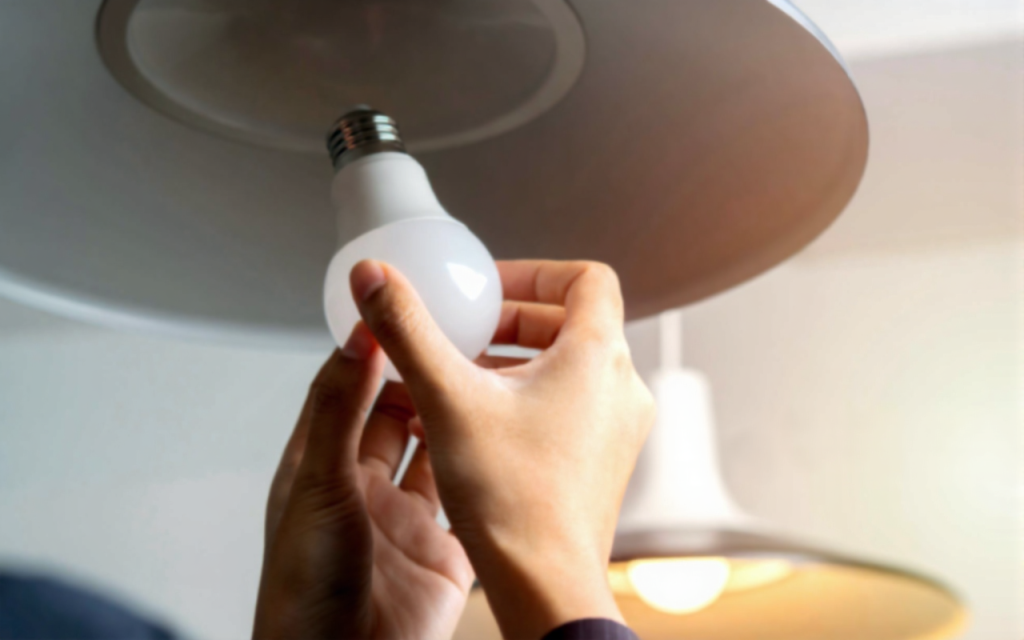
- Install LED bulbs: Screw in LED replacements snugly but don’t overtighten.
- Test operation: Turn on lights and verify proper operation. If using dimmers, test dimming functionality.
- Adjust as needed: If light quality isn’t ideal, try different color temperatures or brightness levels.
Common DIY pitfalls to avoid:
- Installing non-dimmable LEDs with dimmer switches
- Using LEDs not rated for enclosed fixtures in fully enclosed light fixtures
- Selecting wrong color temperature creating unpleasant ambiance
- Overtightening bulbs, which can damage fixtures or bulbs
Upgrading Existing Dimmer Switches
If you experience flickering or buzzing with LED bulbs on dimmer switches, your dimmers likely aren’t compatible with LED technology.
The solution: Replace old incandescent dimmers with LED-compatible dimmers. This is a straightforward electrical project for experienced DIYers comfortable with basic electrical work, or an inexpensive service call for professional electricians.
LED-compatible dimmer features:
- Smooth dimming from 10-100% brightness without flickering
- Quiet operation without buzzing or humming
- Minimum load adjustment for proper operation with efficient LEDs
- Often include features like night-lights, presets, and fade-on/fade-off
Popular LED dimmer brands include Lutron (Diva, Maestro, Caseta), Leviton, and GE, typically costing $15-40 per dimmer.
Professional LED Lighting Upgrades and Retrofits
While bulb replacement is straightforward, comprehensive residential LED upgrade projects often benefit from professional expertise—particularly for recessed lighting, fixture replacement, and whole-home conversions.
Recessed Lighting LED Retrofit
Many homes feature recessed can lights (pot lights) with incandescent or halogen bulbs. These fixtures generate tremendous heat and consume substantial energy, making them prime candidates for LED retrofit.
Retrofit options:
LED retrofit kits: Install into existing recessed cans, replacing the bulb socket assembly with integrated LED modules. These kits cost $10-25 each and provide:
- Improved light distribution with reflector designs
- Reduced ceiling heat penetration
- Updated appearance with trim options
- Easy installation often requiring no electrical work beyond the fixture
Complete LED recessed fixtures: For outdated or damaged recessed cans, replacing entire fixtures with new LED-integrated units provides:
- Latest LED efficiency and light quality
- IC-rated (insulation contact) designs allowing contact with ceiling insulation
- Air-tight designs reducing energy loss through ceiling penetrations
- Slim profiles for shallow ceiling spaces
- 5-10 year warranties on integrated LEDs
Professional installation benefits:
Licensed electricians provide:
- Proper fixture selection for your ceiling type and insulation conditions
- Code-compliant installation ensuring safety
- Correct placement for optimal lighting distribution
- Integration with dimming systems and smart controls
- Warranty protection on both products and installation
Cost considerations:
- DIY retrofit kits: $10-25 per fixture (bulb replacement difficulty)
- Professional retrofit kit installation: $50-80 per fixture including materials
- Complete LED fixture replacement: $100-150 per fixture installed
For homes with 20-30 recessed fixtures, professional whole home LED conversion typically costs $2,000-4,000 but reduces lighting energy consumption by 80-90% while providing superior light quality.
Under-Cabinet and Task Lighting
Under-cabinet lighting illuminates kitchen countertops for food preparation while adding ambiance. LED technology has transformed this application:
LED tape lighting: Flexible LED strips adhere beneath cabinets providing continuous, even illumination. Options include:
- Plug-in systems for easy DIY installation
- Hardwired systems for permanent, professional appearance
- Color temperature selection (warm to cool white)
- Dimmable options for ambiance control
- RGB color-changing options for decorative effects
LED puck lights: Discrete circular fixtures installed beneath cabinets create focused task lighting pools. Available in surface-mount or recessed configurations.
LED linear fixtures: Purpose-built under-cabinet light bars provide excellent task lighting with minimal profile and glare-free illumination.
Professional installation advantages:
- Clean wiring hidden within cabinets
- Integration with kitchen electrical systems
- Proper dimming and control systems
- Code-compliant installation
- Coordinated with existing lighting for comprehensive kitchen illumination
Cost range:
- DIY plug-in LED strips: $30-80 per cabinet section
- Professional hardwired LED systems: $150-300 per cabinet section installed
Outdoor LED Lighting Upgrades
Outdoor lighting—landscape, security, and architectural lighting—benefits tremendously from LED conversion:
Landscape path and accent lights: LED replacements for low-voltage landscape lighting reduce transformer loads by 80%, allowing more lights per transformer. LEDs’ cool operation prevents burning landscape plants touching fixtures.
Security and flood lights: LED security lights provide brilliant illumination using 10-20 watts instead of 150-250 watts for halogen equivalents. Many feature motion sensing, photocells, and smart controls.
Architectural and decorative lighting: LED strip lights, spotlights, and wall-mounted fixtures highlight architectural features with minimal energy consumption and virtually no maintenance for decades.
Professional outdoor LED installation:
- Proper weatherproofing and fixture mounting
- Correct transformer sizing for LED loads
- Strategic placement for optimal illumination and aesthetics
- Integration with smart controls and timers
- Low-voltage wiring best practices
Whole-Home LED Conversion Planning
Systematic whole home LED conversion maximizes benefits while minimizing costs and disruption.
Room-by-Room Upgrade Strategy
Priority 1—High-use areas (immediate ROI):
- Kitchen (typically 10-15 fixtures)
- Living room/family room (10-20 fixtures including recessed lighting)
- Home office (5-10 fixtures)
- Bathrooms (5-10 fixtures total)
These areas have lights operating 3-8 hours daily, providing fastest payback periods of 6-18 months.
Priority 2—Medium-use areas (quick ROI):
- Bedrooms (3-5 fixtures per room)
- Hallways and staircases (5-10 fixtures)
- Dining room (3-8 fixtures)
- Laundry room (2-4 fixtures)
Moderate use patterns deliver ROI within 1-2 years.
Priority 3—Low-use areas (longer ROI):
- Closets (10-20 small fixtures throughout home)
- Garage/workshop (2-8 fixtures)
- Basements (5-15 fixtures)
- Storage areas (2-5 fixtures)
While ROI takes longer (2-4 years), comprehensive conversion eliminates all remaining inefficient lighting.
Creating Your LED Upgrade Budget
Budget-friendly approach ($300-800):
- Replace all bulbs in high-use areas with quality LED bulbs
- DIY installation
- Use existing fixtures and dimmers (replace incompatible dimmers as needed)
- Phase remaining areas over 6-12 months
Standard upgrade ($1,000-2,500):
- Replace all bulbs throughout home
- Upgrade all dimmer switches to LED-compatible units
- Professional installation of recessed LED retrofits in 10-20 fixtures
- Add under-cabinet LED lighting in kitchen
Comprehensive professional conversion ($3,000-6,000):
- Complete bulb replacement throughout home
- Full recessed lighting retrofit or replacement (20-40 fixtures)
- Professional-grade under-cabinet and task lighting
- Outdoor landscape and security LED upgrades
- Smart lighting system integration
- LED-compatible dimmer and switch upgrades
Return on Investment Timeline
Energy savings calculation example (40-fixture home):
- Current incandescent cost: $315/year electricity + $50/year bulbs = $365/year
- LED cost: $42/year electricity + $4/year bulbs (minimal due to longevity) = $46/year
- Annual savings: $319
Investment recovery:
- Budget DIY conversion ($600): 1.9 years payback
- Standard upgrade ($1,800): 5.6 years payback
- Comprehensive professional ($4,500): 14 years payback
While comprehensive conversions have longer payback periods, they deliver additional benefits including dramatically improved light quality, eliminated maintenance, enhanced safety, smart home integration, and increased property value that aren’t captured in simple ROI calculations.
Smart LED Lighting Integration
Modern LED light installation often includes smart capabilities transforming how you control and experience lighting.
Smart Bulb Options
WiFi smart bulbs: Connect directly to home WiFi networks and control via smartphone apps. Popular brands include Philips Hue, LIFX, and Wyze. Features typically include:
- Remote on/off and dimming control
- Color temperature adjustment (warm to cool white)
- Color changing (RGB bulbs)
- Scheduling and automation
- Voice control integration
- No hub required (WiFi connection sufficient)
Hub-based smart lighting systems: Systems like Philips Hue use dedicated hubs connecting to your router, with bulbs communicating via Zigbee or similar protocols. Advantages include:
- More reliable performance than WiFi-only bulbs
- Lower bulb costs after initial hub investment
- Advanced automation capabilities
- Better security (bulbs aren’t directly internet-connected)
- Support for many bulbs on single network
Smart switches and dimmers: Rather than smart bulbs, install smart switches controlling regular LED bulbs. Benefits include:
- Work with any LED bulbs (no special bulbs required)
- Lower long-term costs
- Familiar operation—switches work manually or via apps
- Multiple bulbs controlled by single smart switch
Smart Lighting Automation Examples
Wake-up routines: Gradually increase bedroom lighting over 15-30 minutes simulating sunrise, making waking easier and more natural.
Away-from-home security: Randomize lighting on/off times throughout evening creating lived-in appearance deterring burglars.
Voice control: “Alexa, dim living room lights to 30%” or “Hey Google, turn off all lights” provides convenient hands-free control.
Geofencing: Automatically turn on entry lights when your phone approaches home, turn off all lights when leaving.
Scene creation: Single command activates complex lighting combinations—”Movie night” dims overhead lights, activates accent lighting, and adjusts color temperature.
Integration with other systems: Motion sensors trigger lights automatically, door sensors activate entry lighting, weather conditions adjust outdoor lighting.
Professional Smart Lighting Installation
While smart bulbs are DIY-friendly, comprehensive smart lighting systems benefit from professional installation:
- Strategic switch and bulb selection
- Proper hub placement for reliable communication
- Integration with whole-home automation systems
- Programming complex scenes and automation
- Ensuring reliable operation and troubleshooting issues
LED Lighting for Specific Applications
Different areas benefit from specialized energy efficient home lighting approaches.
Kitchen LED Lighting Design
Layered lighting approach:
- Ambient: Recessed LED ceiling lights providing general illumination
- Task: Under-cabinet LEDs illuminating countertops
- Accent: LED strips inside glass-front cabinets showcasing dishes
- Focal: Pendant LEDs over islands providing decorative element and task lighting
Color temperature considerations: Kitchens typically use 3000-4000K (neutral to cool white) promoting alertness and accurate color perception for food preparation.
Dimming capability: Dimmable LED systems allow bright task lighting during cooking and softer ambiance for dining and entertaining.
Bathroom LED Solutions
Vanity lighting: LED fixtures beside or above mirrors providing even, shadow-free illumination for grooming tasks. Choose fixtures with 3000-3500K color temperature and high CRI (90+) for accurate color rendition.
Shower/tub lighting: LED recessed fixtures rated for wet locations (IP65 or better). Cool operation makes LEDs ideal for enclosed shower fixtures.
Night lights: Motion-activated LED night lights or under-cabinet LEDs provide safe nighttime navigation without harsh overhead lighting.
Bedroom LED Considerations
Warm color temperatures (2700-3000K): Create relaxing atmosphere conducive to sleep.
Dimmable fixtures: Essential for adjusting lighting levels from bright task lighting to soft bedtime ambiance.
Smart bulbs for sleep optimization: Program gradual dimming before bedtime, warm color temperatures in evening, and gradual brightening for wake-up routines.
Home Office LED Requirements
High-quality task lighting: 3500-4500K color temperature with high CRI (90+) reduces eye strain during extended computer work.
Layered approach: Combine ambient overhead lighting with dedicated desk lamps providing focused task illumination.
Glare reduction: Position fixtures and use indirect lighting techniques minimizing screen glare and eye fatigue.
Professional vs. DIY LED Installation
Understanding when to hire professional electricians versus tackling LED upgrades yourself helps balance cost savings with quality results.
DIY-Appropriate LED Projects
Homeowners with basic skills can safely handle:
- Simple bulb replacements in existing fixtures
- Installing LED retrofit kits in recessed cans (following instructions carefully)
- Plug-in LED strips for under-cabinet lighting
- Replacing dimmer switches (if comfortable with basic electrical work)
- Installing battery-powered or plug-in smart bulbs
Projects Requiring Professional Installation
Hire licensed electricians for:
- Installing new recessed fixtures in ceilings (requires cutting holes, running wire, proper insulation clearance)
- Hardwired under-cabinet lighting systems
- Outdoor low-voltage landscape lighting (proper transformer sizing, wire burial, weatherproofing)
- Converting fixtures for LED compatibility when compatibility issues exist
- Installing smart lighting systems requiring new wiring or complex programming
- Any work requiring electrical permits
- Projects where you’re uncertain about safety or proper installation
Professional installation advantages:
- Guaranteed code compliance
- Proper fixture selection for specific applications
- Warranty protection on both products and labor
- Insurance coverage protecting homeowners
- Expertise preventing costly mistakes
- Time savings (professionals complete in hours what might take homeowners days)
Maintenance and Longevity
Energy efficient lighting using LEDs requires minimal maintenance compared to traditional bulbs.
LED Lifespan Expectations
Rated hours: Quality LED bulbs are rated for 25,000-50,000 hours of operation.
Real-world longevity:
- 3 hours daily use: 23-46 years
- 6 hours daily use: 11-23 years
- 12 hours daily use: 6-11 years
Even lights operating 12 hours daily last over half a decade—far exceeding incandescent (1-2 years) or CFL (2-3 years) lifespans.
Minimal Maintenance Requirements
LED lighting maintenance:
- Clean fixtures and bulbs periodically (dust reduces light output)
- Check outdoor fixtures for moisture infiltration
- Verify dimmer compatibility if experiencing flickering
- Replace the rare failed bulb (quality LEDs have <1% failure rates)
No maintenance required:
- No bulb replacements for 10-20+ years
- No fixture repairs due to heat damage (LEDs run cool)
- No special disposal procedures (unlike CFLs containing mercury)
Conclusion: Investing in LED Lighting Excellence
LED lighting upgrades represent among the smartest home improvements available—delivering immediate energy savings, superior light quality, enhanced safety, dramatically reduced maintenance, and rapid return on investment. Whether you implement simple bulb replacements or comprehensive professional lighting system upgrades, converting to LED technology pays dividends for years to come.
The combination of 75-85% energy savings, 25,000-50,000 hour lifespans eliminating constant bulb replacements, improved light quality creating more pleasant living environments, and compatibility with smart home automation makes LED technology the clear choice for all residential lighting needs. The question isn’t whether to upgrade to LEDs—it’s how quickly you can complete the conversion to start enjoying the benefits.
As we move deeper into fall with longer nights requiring more artificial lighting, now is the ideal time to evaluate your home’s lighting and plan LED upgrades that will reduce utility bills throughout winter months and beyond. Start with high-use areas delivering fastest ROI, then systematically convert remaining fixtures as budget allows, or tackle comprehensive whole-home conversions capturing maximum immediate benefits.
Ready to transform your home’s lighting with energy-efficient LED technology? Contact Energized Electric LLC today for professional LED lighting consultation and installation services. Our certified electricians provide expert guidance on fixture selection, comprehensive installation services, smart lighting integration, and ensure your LED upgrade delivers maximum energy savings and lighting quality. Illuminate your home beautifully while dramatically reducing energy costs—start your LED conversion today.
Content strategy and SEO optimization powered by Goodspeed Marketing